
Video Lessons 5 Sections76 LessonsLifetime
What Happens When You Procrastinate Too Much
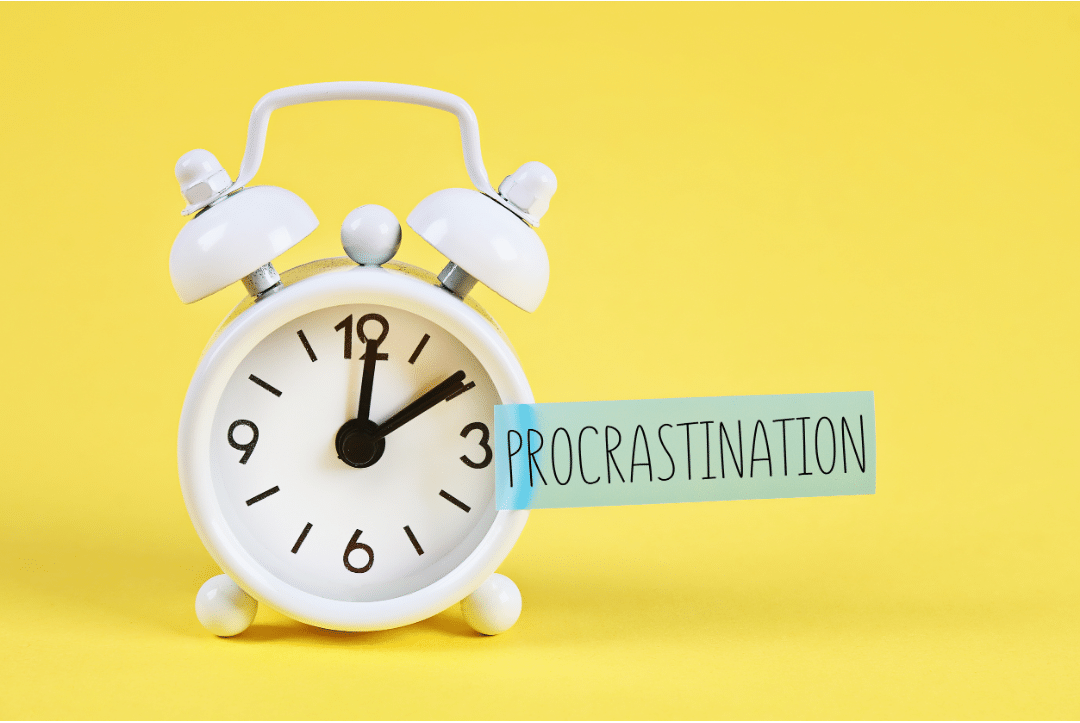
Starting Point. Discuss the questions below.
- What tasks or chores do you usually procrastinate on?
- How do you feel after procrastinating for a long time?
- Do you think procrastination can ever be beneficial?
[intense_collapsibles single_toggle=”1″ content_border=”1px solid #ffe433″] [intense_collapse title=”Extra Info” external_link_target=”_self” title_background_color=”#ffe433″ content_background_color=”#f0f0f0″ title_font_color=”#424242″ content_font_color=”#424242″]
Statistics about the prevalence of procrastination
- Studies show that around 20% of adults procrastinate chronically.
- Studies show that around 50% of college students procrastinate in a consistent and chronic manner, 75% consider themselves to be procrastinators, and 80%–95% of college students procrastinate.
- In a study on an adult sample, 74% of the people who were surveyed indicated that they go to bed later than they planned at least once a week, with no external reason for doing so.
In addition, a 2001 study on a mixed sample (mean age = 29.4, standard deviation 12.0, 51.9% students, 42.5% employed, 3.6% unemployed), found the following:
- Approximately half (50.7%) of the people who were surveyed reported frequently using the internet to procrastinate.
- Across all participants, people spent on average almost half (47%) of their time online procrastinating, amounting to an average of 1.59 hours of internet procrastination each day, though there was substantial variability in this across individuals, meaning that many people procrastinated to a much greater or lower degree than average.
- When it comes to procrastinating using the internet in specific domains, people procrastinated the most when they were home (57% of the time, amounting to 1.12 hours on average out of 1.96 hours spent on the internet), then at school (40% of the time, amounting to 0.26 hours out of 0.65), and finally at work (32% of the time, amounting to 0.24 hours out of 0.75).
source: https://solvingprocrastination.com/procrastination-statistics/
…………..[/intense_collapse] [/intense_collapsibles]
Focus on Vocabulary. Match the words with the correct meaning.
Focus on Comprehension. Answer the questions below about the video.
Focus on Listening. Watch the video. Read the transcript below if necessary.
[intense_collapsibles single_toggle=”1″ content_border=”1px solid #b3efb2″] [intense_collapse title=”Transcript” external_link_target=”_self” title_background_color=”#b3efb2″ content_background_color=”#f0f0f0″ title_font_color=”#424242″ content_font_color=”#424242″]
00:00:00 – [Narrator] Most of us have procrastinated at some point in our lives, but about one in every five of us are compulsive about it. They put off tasks and chores nearly every chance they get. They are called chronic procrastinators, and it turns out this behavior does a lot more damage than you might think. We get it, doing work is hard. But when you choose to watch TV over doing laundry or washing dishes, you’ve just launched an all-out battle in your brain. On one side, you have your prefrontal cortex,
00:00:36 that’s the part of your brain that sets long-term goals and regulates self-control. It’s telling you that those dishes aren’t going to clean themselves. And on the other side is the limbic system. It deals with pleasure, arousal, and reward, and it’s telling you that washing dishes is lame, dude. You’d have a better time doing something else, so procrastination essentially puts your brain in its happy place. It feels good, that’s why you do it. But of course, just because it feels good, doesn’t mean it’s necessarily good for you.
00:01:10 For example, several studies have found that undergraduate college students who procrastinated had a lower GPA in the latter half of the semester compared to non-procrastinators. They were also more likely to get sick based on their healthcare visits. Moreover, other studies have found that procrastinators report higher levels of guilt and anxiety when they choose to procrastinate in the first place. And if you keep it up, researchers have found that chronic procrastination is linked to low self-confidence, low-energy, and depression.
00:01:47 Overall, your quality of life would probably be worse than if you had just listened to that little prefrontal cortex. And you may think that you just have a different workflow or you perform better under pressure, but sorry to say, there are no studies to support any benefits of chronic procrastination. Bottom line, it’s unhealthy, but not all hope is lost. In fact, researchers have conducted dozens of scientific studies in search for ways to help procrastinators. What they’ve found time and time again is how you think about tasks can make
00:02:25 a huge difference in how likely you are to procrastinate on them. Tasks like saving for retirement for example can be so abstract, there’s no immediate deadline, so you can always start tomorrow, and this is the mentality that lead you to procrastinate. Instead, make your tasks more concrete in your mind. For example, a study in 2011 discovered that people given an illustration of how they might look at retirement age were more likely to say they would save money for retirement than people without an illustration.
00:03:01 The image was something tangible, and therefore painted a more concrete picture of their inevitable future. So whatever the task, do your health a favor and do the work right now. You might even enjoy that TV show even more once you get to it.
…………..[/intense_collapse]
Group Task.
[intense_collapsibles single_toggle=”1″ content_border=”1px solid #e60096″] [intense_collapse title=”Task” external_link_target=”_self” title_background_color=”#e60096″ content_background_color=”#f0f0f0″ title_font_color=”#424242″ content_font_color=”#424242″]
Scenario:
Imagine a company has hired a team of behavioral experts to help employees overcome procrastination. In this activity, you will work in pairs, with each pair splitting into two roles: one partner as the Client (a chronic procrastinator struggling with work and daily tasks) and the other as a Behavioral Advisor (an expert tasked with offering advice and practical solutions).
Task Instructions:
-
Step 1 (2 minutes individual brainstorming):
- Clients: Write down two specific tasks you often procrastinate on and how it affects you.
- Advisors: Brainstorm two strategies or techniques that could help overcome procrastination (e.g., breaking tasks into smaller steps, setting concrete deadlines).
-
Step 2 (10 minutes discussion in pairs):
- Role-play a consultation session.
- Clients: Explain your challenges and how procrastination is impacting your work and well-being.
- Advisors: Listen carefully and offer tailored advice, explaining why your strategies can help.
- Use vocabulary from today’s lesson (e.g., “abstract” vs. “concrete,” “chronic procrastination,” “prefrontal cortex,” etc.).
- Discuss potential barriers and how to overcome them.
- Role-play a consultation session.
-
Step 3 (Group Reporting):
- After the role-play, each pair will join with another pair (or two groups merge) so that one group represents Clients and the other Advisors.
- Each group should prepare a brief summary (about 2 minutes) outlining their key challenges and recommendations.
- Present your findings to the class.
…………..[/intense_collapse]
Focus on Speaking.
- What specific tasks cause the most procrastination?
- How do emotions like guilt and anxiety play into the procrastination cycle?
- What concrete steps can help break the cycle of procrastination?
- Should the focus be on changing one’s mindset or modifying the task itself?
