• Link to Facebook
  • Link to Instagram
  • Link to Pinterest
  • Link to LinkedIn
  • Link to WhatsApp
  • Link to Youtube
  • Register
  • Log in
Professional English Academy
  • About me
  • My Courses
    • Mini Lessons
    • Interactive lessons
    • Picture lessons
    • Business Videos
    • Fluency for Work (Vocabulary)
    • IELTS
    • Finance, Accounting, Legal English
    • General Exercises (B2-C1)
    • Grammar for English
    • Writing
    • Pronunciation & Stress
    • 100 Things Everyone Should Know
    • Games and Quizzes
    • Articles and exercises
    • Speaking in Work Situations
    • Video Lessons
  • FAQ
  • Blog
  • Menu Menu
  • Home
  • My courses – LP
  • General English

Video Lessons

Curriculum

  • 5 Sections
  • 76 Lessons
  • Lifetime
Expand all sectionsCollapse all sections
  • 2024-2025
    8
    • 1.1
      What is the exit poll and how does it work?
    • 1.2
      What Happens When You Procrastinate Too Much
    • 1.3
      How to change your personality
    • 1.4
      Gibraltar: What’s inside The Rock?
    • 1.5
      A brief history of Downing Street
    • 1.6
      The rocky 1960s origin of online dating
    • 1.7
      Why do we gossip?
    • 1.8
      How to Build Mental Strength
  • 2023-2024
    6
    • 2.1
      Tips to save money
    • 2.2
      Would you pass the wallet test?
    • 2.3
      One of history’s most dangerous myths
    • 2.4
      The Seed Vault
    • 2.5
      Commuting to work
    • 2.6
      The history of New Year’s Resolutions
  • 2022-2023
    14
    • 3.1
      Critical Thinking
    • 3.2
      Daylight saving time
    • 3.3
      Functional illiteracy in Europe
    • 3.4
      Brain Hacking
    • 3.5
      Conspiracy theories
    • 3.6
      Electric cars
    • 3.7
      How do you survive a zombie attack?
    • 3.8
      How green is green energy?
    • 3.9
      Money
    • 3.10
      Schema
    • 3.11
      Small talk can make you happier
    • 3.12
      The Mango Cult
    • 3.13
      When are you actually an adult?
    • 3.14
      Whodunnit
  • 2022-2022
    19
    • 4.1
      The limits of human memory
    • 4.2
      The history of the United Nations
    • 4.3
      Separated at birth
    • 4.4
      Is nuclear power the solution?
    • 4.5
      Meeting the parents
    • 4.6
      Is ecotourism a sustainable practice?
    • 4.7
      Endangered Languages
    • 4.8
      Constitutional monarchy vs republic
    • 4.9
      China’s Social Credit System
    • 4.10
      As it used to be
    • 4.11
      The Locavore Movement
    • 4.12
      The person who knows how to cheer your day up
    • 4.13
      The Savant
    • 4.14
      The Science of Christmas
    • 4.15
      The Zero Waste Lifestyle
    • 4.16
      What might Bill Gates be worried about?
    • 4.17
      Who should tackle misinformation on social media?
    • 4.18
      Why videos go viral
    • 4.19
      World Peace Games
  • 2021-2022
    29
    • 5.1
      #32 Should you trust strangers?
    • 5.2
      #31 The Ravens of the Tower of London
    • 5.3
      #30 Food waste
    • 5.4
      #29 Unpaid workers
    • 5.5
      #28 Anti-social Behaviour?
    • 5.6
      #27 Urbanisation
    • 5.7
      #26 The Dark Side of Self-improvement
    • 5.8
      #25 The history of chocolate
    • 5.9
      #24 Thank god you are here!
    • 5.10
      #23 Test Tube Meat
    • 5.11
      #22 Escape from the Grand Canyon
    • 5.12
      #20 Should we embrace GMO food?
    • 5.13
      #19 Bletchley Park
    • 5.14
      #18 Money
    • 5.15
      #17 How many friends can you have?
    • 5.16
      #16 Success
    • 5.17
      #15 Studies of panicking crowds
    • 5.18
      #14 The benefits of paternity leave
    • 5.19
      #13 Keep calm and carry on
    • 5.20
      #12 The history of the English language
    • 5.21
      #11 St. Patrick’s Day
    • 5.22
      #10 National Anthem
    • 5.23
      #8 What counts as political corruption?
    • 5.24
      #7 How an amateur built the world’s biggest dome
    • 5.25
      #5 Cycle Superhighway London
    • 5.26
      #6 Does Child Labour Help Children in Poverty?
    • 5.27
      #3 How computers threaten the job of mid-skilled workers
    • 5.28
      #2 Should you be allowed to sell your kidney?
    • 5.29
      #1 Surviving quicksand

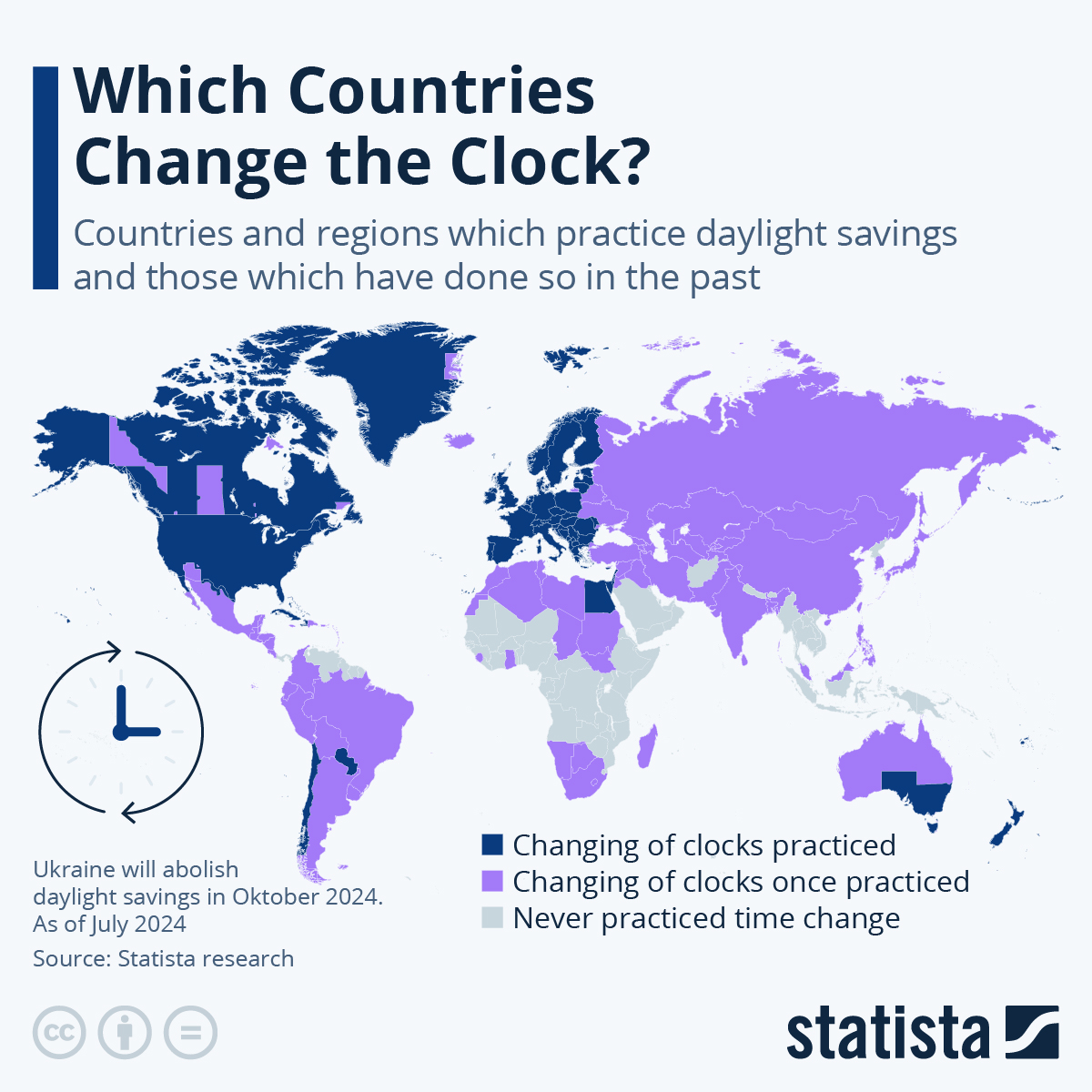
Daylight saving time

Chart: Which Countries Change the Clock? | Statista

[intense_content_section background_type=”color” background_color=”#FCFCF4″]

Starting Point. Discuss the questions below.

What do you know about daylight saving time (DST)?

Do you like it? Why (not)?

What impact does DST have on your life?

Can you think about the benefits and the disadvantages?

Check out this interesting infographics: https://visual.ly/community/Infographics/environment/winners-losers-daylight-savings-time 


Pros and Cons

Benefits of Daylight Saving Time:

  1. Energy Conservation: The primary reason for implementing Daylight Saving Time is to save energy by reducing the demand for electricity in the evenings. With more daylight hours in the evenings, people are less likely to use electric lights and appliances, which can save energy and reduce greenhouse gas emissions.
  2. Increased Recreational Opportunities: Daylight Saving Time provides more daylight hours in the evenings, which allows people to engage in outdoor recreational activities such as sports, exercise, and socializing.
  3. Boost to Local Economies: With more daylight hours in the evenings, businesses such as restaurants, bars, and retail shops may experience increased foot traffic and revenue, especially in tourist areas.

Drawbacks of Daylight Saving Time:

  1. Health Effects: The abrupt time change of Daylight Saving Time can disrupt sleep patterns, causing fatigue, irritability, and even increasing the risk of heart attacks, strokes, and traffic accidents.
  2. Economic Costs: Daylight Saving Time can have a negative impact on the economy, particularly in industries that rely on consistent hours of daylight, such as agriculture and transportation. The time change can cause confusion and errors in scheduling and can negatively impact the productivity of workers.
  3. Minimal Energy Savings: While Daylight Saving Time is intended to save energy, there is a growing body of research that suggests the energy savings may be minimal or nonexistent, and in some cases, the time change may actually increase energy consumption.
  4. Disruptive to Daily Life: The time change can be disruptive to daily life, causing confusion and missed appointments, and can be particularly difficult for people with medical conditions, young children, and the elderly.
  5. Regional Differences: Daylight Saving Time is not uniformly adopted across the world or even within countries, leading to confusion and complications for travelers and businesses that operate across time zones.

Focus on Vocabulary. Match the words with the correct meaning.

Focus on Comprehension. Answer the questions below about the video.

  1. What are some of the benefits of Daylight Saving Time mentioned in the video?
  2. What are some of the drawbacks of Daylight Saving Time mentioned in the video?
  3. What is the history of Daylight Saving Time, and how has it evolved over time?
  4. What are some of the current controversies surrounding Daylight Saving Time?
  5. What are some of the global differences in how Daylight Saving Time is implemented?

Focus on Listening. Watch the video. Read the transcript below if necessary.

Transcript

Focus on Speaking. 

  1. What are some of the potential impacts of abolishing Daylight Saving Time?
  2. What are some alternative proposals for adjusting time to maximize daylight hours?
  3. Should daylight saving time be abolished?
  4. Does daylight saving time still serve its original purpose?
  5. Should the duration of daylight saving time be extended or shortened?
  6. Is daylight saving time an effective way to conserve energy?
  7. Should states have the right to opt out of daylight saving time?
  8. Does daylight saving time have a negative impact on public health?
  9. Should daylight saving time be standardized across the entire country?
  10. Does daylight saving time have a positive or negative impact on the economy?
  11. Should daylight saving time be implemented globally?
  12. Is it time to rethink the idea of daylight saving time altogether?


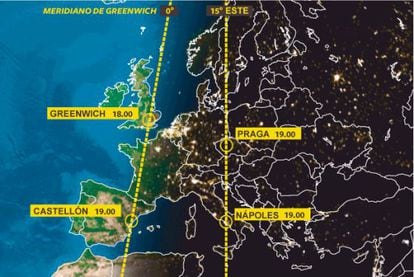
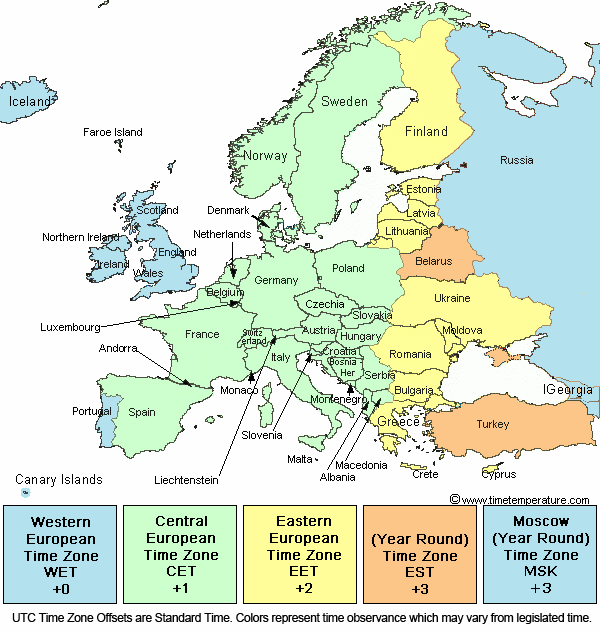
Current time zones:
European Union To End Daylight Saving Time - Summer TimeSpain: out of time | Spain | EL PAÍS English

https://www.euronews.com/my-europe/2022/10/28/when-will-the-eu-end-seasonal-clock-changes-only-time-will-tell

https://www.statista.com/chart/15322/europeans-want-to-abolish-daylight-savings/

[/intense_content_section]

Critical Thinking
Prev
Functional illiteracy in Europe
Next

Professional English

Online English Language Trainer for busy professionals

Madrid

Spain

Opening Hours

Monday           07:00–23:00
Tuesday           07:00–23:00
Wednesday     07:00–23:00
Thursday         07:00–23:00
Friday              07:00–23:00
Saturday          08:00–17:00
Sunday            Closed

© Copyright - English for Professionals
  • Link to Facebook
  • Link to Instagram
  • Link to Pinterest
  • Link to LinkedIn
  • Link to WhatsApp
  • Link to Youtube
  • Terms and Conditions
  • Terms of Service
  • Privacy Policy and Data Protection
  • Acknowledgement
Link to: Business Videos Link to: Business Videos Business Videos
Scroll to top Scroll to top Scroll to top
Manage Consent
To provide the best experiences, we use technologies like cookies to store and/or access device information. Consenting to these technologies will allow us to process data such as browsing behaviour or unique IDs on this site. Not consenting or withdrawing consent, may adversely affect certain features and functions.
Functional Always active
The technical storage or access is strictly necessary for the legitimate purpose of enabling the use of a specific service explicitly requested by the subscriber or user, or for the sole purpose of carrying out the transmission of a communication over an electronic communications network.
Preferences
The technical storage or access is necessary for the legitimate purpose of storing preferences that are not requested by the subscriber or user.
Statistics
The technical storage or access that is used exclusively for statistical purposes. The technical storage or access that is used exclusively for anonymous statistical purposes. Without a subpoena, voluntary compliance on the part of your Internet Service Provider, or additional records from a third party, information stored or retrieved for this purpose alone cannot usually be used to identify you.
Marketing
The technical storage or access is required to create user profiles to send advertising, or to track the user on a website or across several websites for similar marketing purposes.
  • Manage options
  • Manage services
  • Manage {vendor_count} vendors
  • Read more about these purposes
View preferences
  • {title}
  • {title}
  • {title}
 
Send this to a friend