
• Link to Facebook
  • Link to Instagram
  • Link to Pinterest
  • Link to LinkedIn
  • Link to WhatsApp
  • Link to Youtube
  • Register
  • Log in
Professional English Academy
  • About me
  • My Courses
    • Mini Lessons
    • Interactive lessons
    • Picture lessons
    • Business Videos
    • Fluency for Work (Vocabulary)
    • IELTS
    • Finance, Accounting, Legal English
    • General Exercises (B2-C1)
    • Grammar for English
    • Writing
    • Pronunciation & Stress
    • 100 Things Everyone Should Know
    • Games and Quizzes
    • Articles and exercises
    • Speaking in Work Situations
    • Video Lessons
  • FAQ
  • Blog
  • Menu Menu
  • Home
  • My courses – LP
  • General English

Video Lessons

Curriculum

  • 5 Sections
  • 76 Lessons
  • Lifetime
Expand all sectionsCollapse all sections
  • 2024-2025
    8
    • 1.1
      What is the exit poll and how does it work?
    • 1.2
      What Happens When You Procrastinate Too Much
    • 1.3
      How to change your personality
    • 1.4
      Gibraltar: What’s inside The Rock?
    • 1.5
      A brief history of Downing Street
    • 1.6
      The rocky 1960s origin of online dating
    • 1.7
      Why do we gossip?
    • 1.8
      How to Build Mental Strength
  • 2023-2024
    6
    • 2.1
      Tips to save money
    • 2.2
      Would you pass the wallet test?
    • 2.3
      One of history’s most dangerous myths
    • 2.4
      The Seed Vault
    • 2.5
      Commuting to work
    • 2.6
      The history of New Year’s Resolutions
  • 2022-2023
    14
    • 3.1
      Critical Thinking
    • 3.2
      Daylight saving time
    • 3.3
      Functional illiteracy in Europe
    • 3.4
      Brain Hacking
    • 3.5
      Conspiracy theories
    • 3.6
      Electric cars
    • 3.7
      How do you survive a zombie attack?
    • 3.8
      How green is green energy?
    • 3.9
      Money
    • 3.10
      Schema
    • 3.11
      Small talk can make you happier
    • 3.12
      The Mango Cult
    • 3.13
      When are you actually an adult?
    • 3.14
      Whodunnit
  • 2022-2022
    19
    • 4.1
      The limits of human memory
    • 4.2
      The history of the United Nations
    • 4.3
      Separated at birth
    • 4.4
      Is nuclear power the solution?
    • 4.5
      Meeting the parents
    • 4.6
      Is ecotourism a sustainable practice?
    • 4.7
      Endangered Languages
    • 4.8
      Constitutional monarchy vs republic
    • 4.9
      China’s Social Credit System
    • 4.10
      As it used to be
    • 4.11
      The Locavore Movement
    • 4.12
      The person who knows how to cheer your day up
    • 4.13
      The Savant
    • 4.14
      The Science of Christmas
    • 4.15
      The Zero Waste Lifestyle
    • 4.16
      What might Bill Gates be worried about?
    • 4.17
      Who should tackle misinformation on social media?
    • 4.18
      Why videos go viral
    • 4.19
      World Peace Games
  • 2021-2022
    29
    • 5.1
      #32 Should you trust strangers?
    • 5.2
      #31 The Ravens of the Tower of London
    • 5.3
      #30 Food waste
    • 5.4
      #29 Unpaid workers
    • 5.5
      #28 Anti-social Behaviour?
    • 5.6
      #27 Urbanisation
    • 5.7
      #26 The Dark Side of Self-improvement
    • 5.8
      #25 The history of chocolate
    • 5.9
      #24 Thank god you are here!
    • 5.10
      #23 Test Tube Meat
    • 5.11
      #22 Escape from the Grand Canyon
    • 5.12
      #20 Should we embrace GMO food?
    • 5.13
      #19 Bletchley Park
    • 5.14
      #18 Money
    • 5.15
      #17 How many friends can you have?
    • 5.16
      #16 Success
    • 5.17
      #15 Studies of panicking crowds
    • 5.18
      #14 The benefits of paternity leave
    • 5.19
      #13 Keep calm and carry on
    • 5.20
      #12 The history of the English language
    • 5.21
      #11 St. Patrick’s Day
    • 5.22
      #10 National Anthem
    • 5.23
      #8 What counts as political corruption?
    • 5.24
      #7 How an amateur built the world’s biggest dome
    • 5.25
      #5 Cycle Superhighway London
    • 5.26
      #6 Does Child Labour Help Children in Poverty?
    • 5.27
      #3 How computers threaten the job of mid-skilled workers
    • 5.28
      #2 Should you be allowed to sell your kidney?
    • 5.29
      #1 Surviving quicksand

#22 Escape from the Grand Canyon

[intense_content_section background_type=”color” background_color=”#ffffff”]Grand Canyon National Park turns 100: 12 facts about the Arizona ...
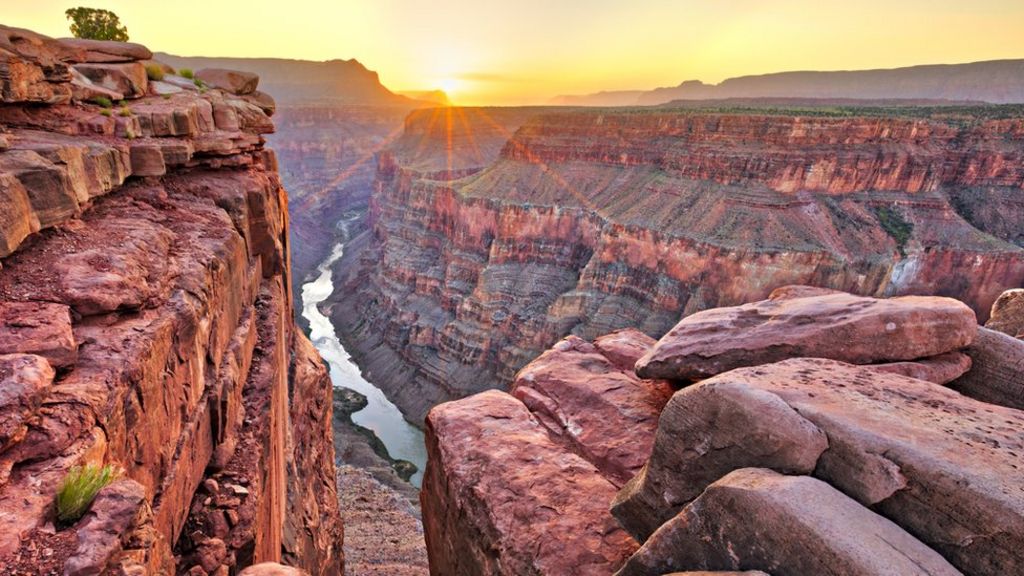
Starting Point. Discuss the questions below.

[intense_alert color=”#E8ECF2″ border_radius=”10px”]

  • The Grand Canyon is 277 miles (446 kilometres) in length.
  • At its widest point the Grand Canyon stretches 18 miles (29 kilometres) across.
  • At its narrowest point it stretches 4 miles (6.4 kilometres) across.
  • The Grand Canyon is around 6000 (1800 metres) feet deep.
  • The different types of rock visible in the Grand Canyon make it an important site for geological research.
  • The rock found at the bottom of the Grand Canyon (schist) is around 2 billion years old.
  • The rock found on the upper rim (limestone) is around 230 million years old.
  • American Indians have been living in and around the canyon for thousands of years.
  • John Wesley Powell led the first expedition down the Grand Canyon in 1869. He was the first to use the name “Grand Canyon” after it had previous been known as the “Big Canyon” or “Great Canyon”.
  • The Grand Canyon became a national park in 1919.
  • Around 5 million visitors enjoying its immense beauty every year.

http://www.sciencekids.co.nz/sciencefacts/earth/grandcanyon.html

[/intense_alert]

Look at the picture and read the text about the Grand Canyon. Then discuss the questions with your partners.

  1. How would you describe the landscape in the Grand Canyon?
  2. Imagine you were planning to make a day trip to the Grand Canyon in the summer. What activities would you choose to do?
  3. List as many potential problems as possible.
  4. What would you take with you for a day trip and what precautions would you take?

Focus on Vocabulary. Match the words with the correct meaning.

Focus on Listening. You are going to watch the video about Aron Ralston and his deadly adventure in the Grand Canyon. Read the transcript below if necessary.


Transcript

You’re never more grateful for being alive then after you just almost died. And i was i was dead. I wasn’t just almost dead. I was dead for six days. There is a sense in my life that this will be part of my life forever and ever. Yeah I’m the guy who cut his arm off.

In 2003 his story made national headlines. A solo hiker trapped by a canyon boulder, forced to take drastic measures to free himself.

There’s a burden to feel that I feel. Hey here’s the privilege of having your life you know so now what do i do?

Six years later 33-year-old Aaron Ralston struggles to answer that question.

Get myself into a position where I’m grabbing on to one of the sides of the boulder. The back of the boulder. And i can work my my legs down first until then…

It was not the way he intended to find fame.

A windy day in February

Instead in his early 20s Ralston hoped to become the first to climb all of Colorado’s 14,000 foot peaks. Solo during winter.

It was experience of risk for the sake of self-discovery. I had this these insecurities of really if I was adequate enough, if I was good enough, if I was good at anything. And then in order to feel something I had to be in riskier environments.

But a solo hike, begun in Blue John Canyon Utah in April of 2003, presented minimal risks. Save for one nearly fatal decision.

As I went out there I made a choice. Not only to be by myself, but I didn’t tell anyone where I was going.

Alone, in a remote part of the canyon the boulder he was climbing became loose.

The boulder ricocheted between the walls and it ensnared my my right hand. And then settled between the walls again so that i became trapped. My arm was crushed flat for about the last eight to nine inches. We always make choices of what we want in our life. So, for some reason I had wanted that experience. What would I do if I were in a situation where my life was on the line? Oh, you really wanted to know? Well, here, you’re gonna find out hear.

Remarkably, he documented the hours and days that followed using his digital camera.

I spent six days there trapped, until, finally, I had an epiphany of how i could get myself free by first breaking the bones in my arm, and then using the knife that I had to cut through the soft tissues and extract myself.

Media attention was instantaneous. But privately the 27-year-old grappled with the meaning of his survival.

You imagine, like, if your grandmother gives you a sweater for Christmas that, like, that you feel a little bit of pressure to make sure you wear it. So, like, imagine like the gift of having your life, like, I feel a little bit of pressure.

The wilderness gave me a gift of my life. It’s given us all a gift of this story of courage.

Six years later he is both blessed by and beholden to the notoriety. He works full-time as a motivational speaker. And his 2004 book has been optioned for film.

I work with being accepting that this is my life. Very inspiring to me. And yet it i also have conversations with my girlfriend about what is my life outside of that. All right climbing. I still have an element of of adventure and exploration and discovery in my life. But I also understand that that there’s a fullness and a wholeness that’s here and this aliveness that comes more from being more open and not needing to feel so extreme.

And still questions of identity persist.

Even years later people feel that, like, why are we paying attention to him? What, why, like, why are we celebrating this this guy who kind of was an idiot and made a big mistake? And – isn’t that talented of a climber and all the rest of this. And I’m just, like, yeah, totally, tell me when you figure it out because I’d like to know, okay?

Focus on Comprehension. Answer the questions below about the video.

  1. What happened to Aron?
  2. When did the accident happened?
  3. Where did the accident happen?
  4. How old was he when the accident happened?
  5. What did Aron want to achieve at that time?
  6. Why did he go alone?
  7. How many days did he spend trapped?
  8. How did he extract himself?
  9. What is his job now?
  10. How has his life changed?
  11. What does Aron think about the reasons for the accident?
  12. How has his attitude to life has changed as a result?
  13. What questions does he have for himself?

Focus on Speaking. 

Aron Ralston made a complete recovery, and in 2011 a film was made about his adventure – 127 Hours. He has praised the  film’s accuracy, saying it was ‘as close to a documentary as you can get and still be a drama.’ Ralston is now married with a young son and lives in Boulder, Colorado. He continues to hike and climb.

Do you agree with Aron’s decision not to tell anyone where he was going?

What would you do in a similar, life-threatening situation?

[/intense_content_section]

#23 Test Tube Meat
Prev
#20 Should we embrace GMO food?
Next

Professional English

Online English Language Trainer for busy professionals

Madrid

Spain

Opening Hours

Monday           07:00–23:00
Tuesday           07:00–23:00
Wednesday     07:00–23:00
Thursday         07:00–23:00
Friday              07:00–23:00
Saturday          08:00–17:00
Sunday            Closed

© Copyright - English for Professionals
  • Link to Facebook
  • Link to Instagram
  • Link to Pinterest
  • Link to LinkedIn
  • Link to WhatsApp
  • Link to Youtube
  • Terms and Conditions
  • Terms of Service
  • Privacy Policy and Data Protection
  • Acknowledgement
Link to: Business Videos Link to: Business Videos Business Videos
Scroll to top Scroll to top Scroll to top
Manage Consent
To provide the best experiences, we use technologies like cookies to store and/or access device information. Consenting to these technologies will allow us to process data such as browsing behaviour or unique IDs on this site. Not consenting or withdrawing consent, may adversely affect certain features and functions.
Functional Always active
The technical storage or access is strictly necessary for the legitimate purpose of enabling the use of a specific service explicitly requested by the subscriber or user, or for the sole purpose of carrying out the transmission of a communication over an electronic communications network.
Preferences
The technical storage or access is necessary for the legitimate purpose of storing preferences that are not requested by the subscriber or user.
Statistics
The technical storage or access that is used exclusively for statistical purposes. The technical storage or access that is used exclusively for anonymous statistical purposes. Without a subpoena, voluntary compliance on the part of your Internet Service Provider, or additional records from a third party, information stored or retrieved for this purpose alone cannot usually be used to identify you.
Marketing
The technical storage or access is required to create user profiles to send advertising, or to track the user on a website or across several websites for similar marketing purposes.
  • Manage options
  • Manage services
  • Manage {vendor_count} vendors
  • Read more about these purposes
View preferences
  • {title}
  • {title}
  • {title}
 
Send this to a friend