• Link to Facebook
  • Link to Instagram
  • Link to Pinterest
  • Link to LinkedIn
  • Link to WhatsApp
  • Link to Youtube
  • Register
  • Log in
Professional English Academy
  • About me
  • My Courses
    • Mini Lessons
    • Interactive lessons
    • Picture lessons
    • Business Videos
    • Fluency for Work (Vocabulary)
    • IELTS
    • Finance, Accounting, Legal English
    • General Exercises (B2-C1)
    • Grammar for English
    • Writing
    • Pronunciation & Stress
    • 100 Things Everyone Should Know
    • Games and Quizzes
    • Articles and exercises
    • Speaking in Work Situations
    • Video Lessons
  • FAQ
  • Blog
  • Menu Menu

Last updated on September 26th, 2023 at 11:16 pm

[intense_content_section background_type=”color” background_color=”#ffffff”]The pronunciation of words ending in -ed can be rather challenging for most English language learners. If you are like most of my students, then most likely you also find it hard to pronounce the -ed correctly. In this short article, I will explain you the rules of pronunciation and I will also give you a life-saving quick tip that helps in every situation.

Why is it important to get -ed right?

The English language is famous for its lack of, or very minimal, conjugation. There are only three word endings (-ed, -s, -ing) that can be considered conjugation, and because there are only three of them, it is very important to get them right and express the correct meaning.

When do we use it?

We add -ed to regular verbs to form the past and past participle (second and third form). We use the past form in simple past sentences to talk about the past. We use the past participle in present perfect and past perfect sentences, in passive sentences and also as adjectives. As you can see, -ed is quite an important element of English grammar since it can express several different meanings.

How do we pronounce it?

Although the rules of pronunciation are quite long, they are surprisingly simple. There are three ways to pronounce -ed: /t/, /d/ and /id/.

  1. We say /t/ after voiceless consonant sounds: /p/, /s/, /k/, /f/, /ʃ/, /tʃ/, /θ/
  2. We say /d/ after voiced consonant sounds: /b/, /g/, /l/, /z/, /v/, /dʒ/, /ð/, /r/, /m/, /n/, /ŋ/ and all vowel sounds
  3. We say /id/ after the following sounds: /t/ and /d/[/intense_content_section]
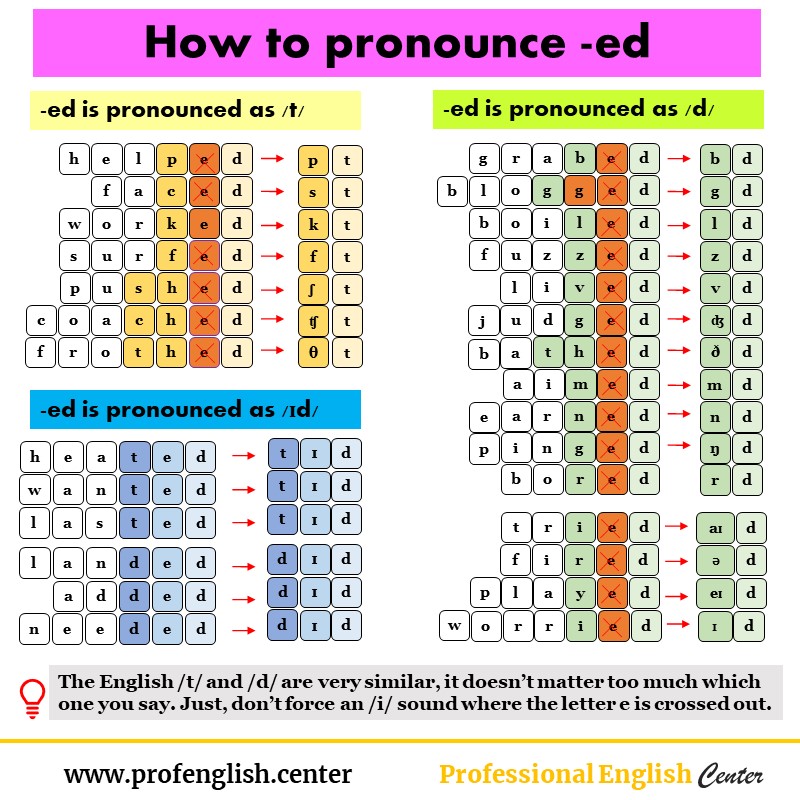
The /t/ and /d/ sounds in English are relatively soft and, depending on the sounds around them, can even sound the same! So, don’t worry too much about whether you have to say /t/ or /d/, your brain, tongue and mouth will automatically know it. Just make sure that you are not forcing and /i/ sound in front of /t/ or /d/ in group 1 and 2.

Exercise 1.

http://profenglish.eu/wp-content/uploads/2020/02/Ed-part1.m4a

Exercise 2.

Listen to the audio and drag the words into the correct box. You can repeat the audio as many times as you like it.

http://profenglish.eu/wp-content/uploads/2020/02/Ed-part-2.m4a

Blog Posts

  • Review Quiz – Vocab
  • Review Quiz
  • Double Subject Quiz
  • Virtual meetings
  • The Christmas Convo Challenge

Professional English

Online English Language Trainer for busy professionals

Madrid

Spain

Opening Hours

Monday           07:00–23:00
Tuesday           07:00–23:00
Wednesday     07:00–23:00
Thursday         07:00–23:00
Friday              07:00–23:00
Saturday          08:00–17:00
Sunday            Closed

© Copyright - English for Professionals
  • Link to Facebook
  • Link to Instagram
  • Link to Pinterest
  • Link to LinkedIn
  • Link to WhatsApp
  • Link to Youtube
  • Terms and Conditions
  • Terms of Service
  • Privacy Policy and Data Protection
  • Acknowledgement
Link to: Business abbreviations and acronyms Link to: Business abbreviations and acronyms Business abbreviations and acronyms Link to: How to pronounce -ism? Link to: How to pronounce -ism? How to pronounce -ism?
Scroll to top Scroll to top Scroll to top
Manage Consent
To provide the best experiences, we use technologies like cookies to store and/or access device information. Consenting to these technologies will allow us to process data such as browsing behaviour or unique IDs on this site. Not consenting or withdrawing consent, may adversely affect certain features and functions.
Functional Always active
The technical storage or access is strictly necessary for the legitimate purpose of enabling the use of a specific service explicitly requested by the subscriber or user, or for the sole purpose of carrying out the transmission of a communication over an electronic communications network.
Preferences
The technical storage or access is necessary for the legitimate purpose of storing preferences that are not requested by the subscriber or user.
Statistics
The technical storage or access that is used exclusively for statistical purposes. The technical storage or access that is used exclusively for anonymous statistical purposes. Without a subpoena, voluntary compliance on the part of your Internet Service Provider, or additional records from a third party, information stored or retrieved for this purpose alone cannot usually be used to identify you.
Marketing
The technical storage or access is required to create user profiles to send advertising, or to track the user on a website or across several websites for similar marketing purposes.
  • Manage options
  • Manage services
  • Manage {vendor_count} vendors
  • Read more about these purposes
View preferences
  • {title}
  • {title}
  • {title}